
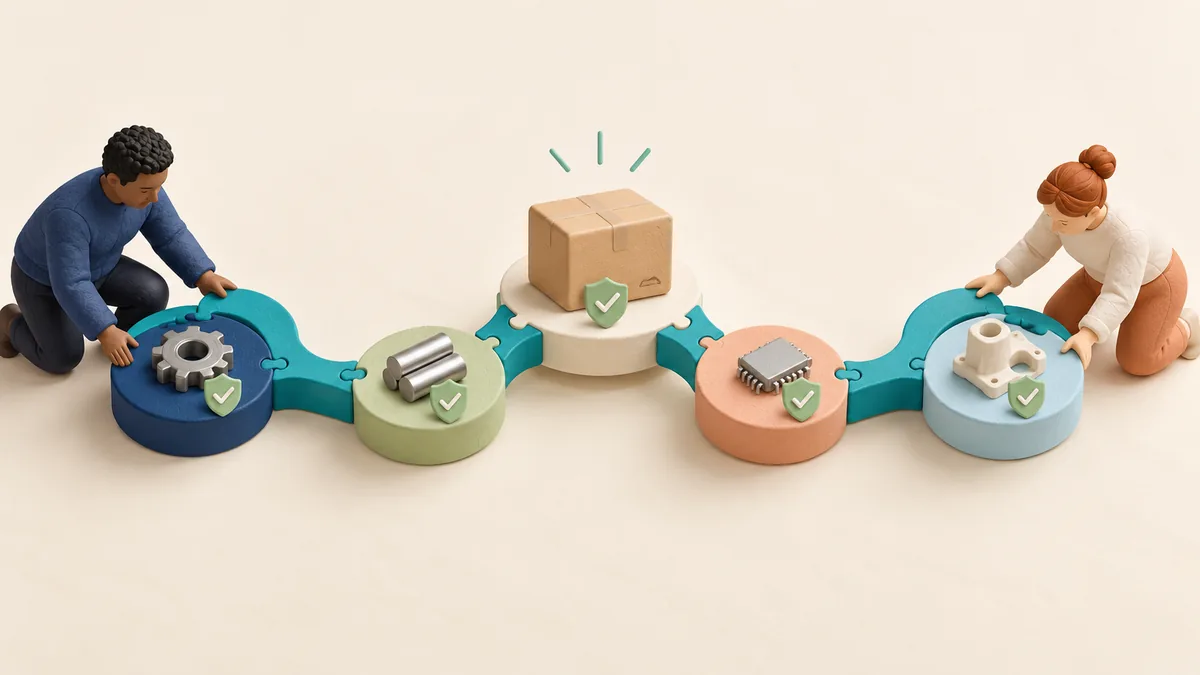
Connect supplier events to recorded costs
A late or unsuitable delivery can generate investigation, rework or additional purchasing effort. Estimate its effect from the actual event records and finance data. Define the supplier, service, time period and affected process. Avoid attributing all operating problems to one supplier simply because several events occurred together.
ASQ's cost-of-quality framework groups costs into prevention, appraisal, internal failure and external failure. These categories offer a starting point for organizing your records; they do not predict the return from a particular supplier program or software purchase.
Build a consistent cost record
- Record the event, relevant requirement and supporting evidence.
- Identify the work performed and the person responsible for confirming it.
- Use agreed rates or actual expenditure, with currency and reporting period.
- Separate supplier-related costs from unrelated causes and uncertain allocations.
- Track any reimbursement so the same expense is not counted twice.
Include the cost of review and prevention as well as failures. A program that adds more inspections may change both the review workload and failure costs. Compare the total within the chosen scope and explain any missing data. An incomplete register can still guide investigation, but it should not be presented as a complete financial result.
Test whether a follow-up action helped
Illustrative workflow: after repeated unsuitable deliveries, a team agrees a clearer specification and a review point with the supplier. It tracks comparable deliveries, rejection rates and investigation time before and after the change. The owner checks whether volume, product mix or another process changed during the comparison. This is a hypothetical measurement method, not a customer success story.
A decline in recorded incidents may justify continuing the approach, but a short observation period can leave uncertainty. Set another review date and record what would trigger escalation. Claims about avoided incidents require an explicit counterfactual assumption; a problem that did not occur is not automatically a verified saving.
Use the result to make a decision
Present measured expenditure, recovered staff capacity and estimated avoided costs separately. Include implementation and ongoing review costs. Let the responsible decision-maker choose whether to continue, revise or stop the action using the evidence and its limitations.
For the review itself, see supplier requirements, risks and follow-up. Use the QMS software evaluation guide to test finding records and following actions through to closure. Software requires maintained source data and accountable review; this article asserts no automatic checking, guaranteed cost reduction or certification outcome.
Reference checked 7 October 2026: ASQ's public cost-of-quality framework above. The proposed workflow uses local evidence and does not establish Qlutch customer outcomes.